




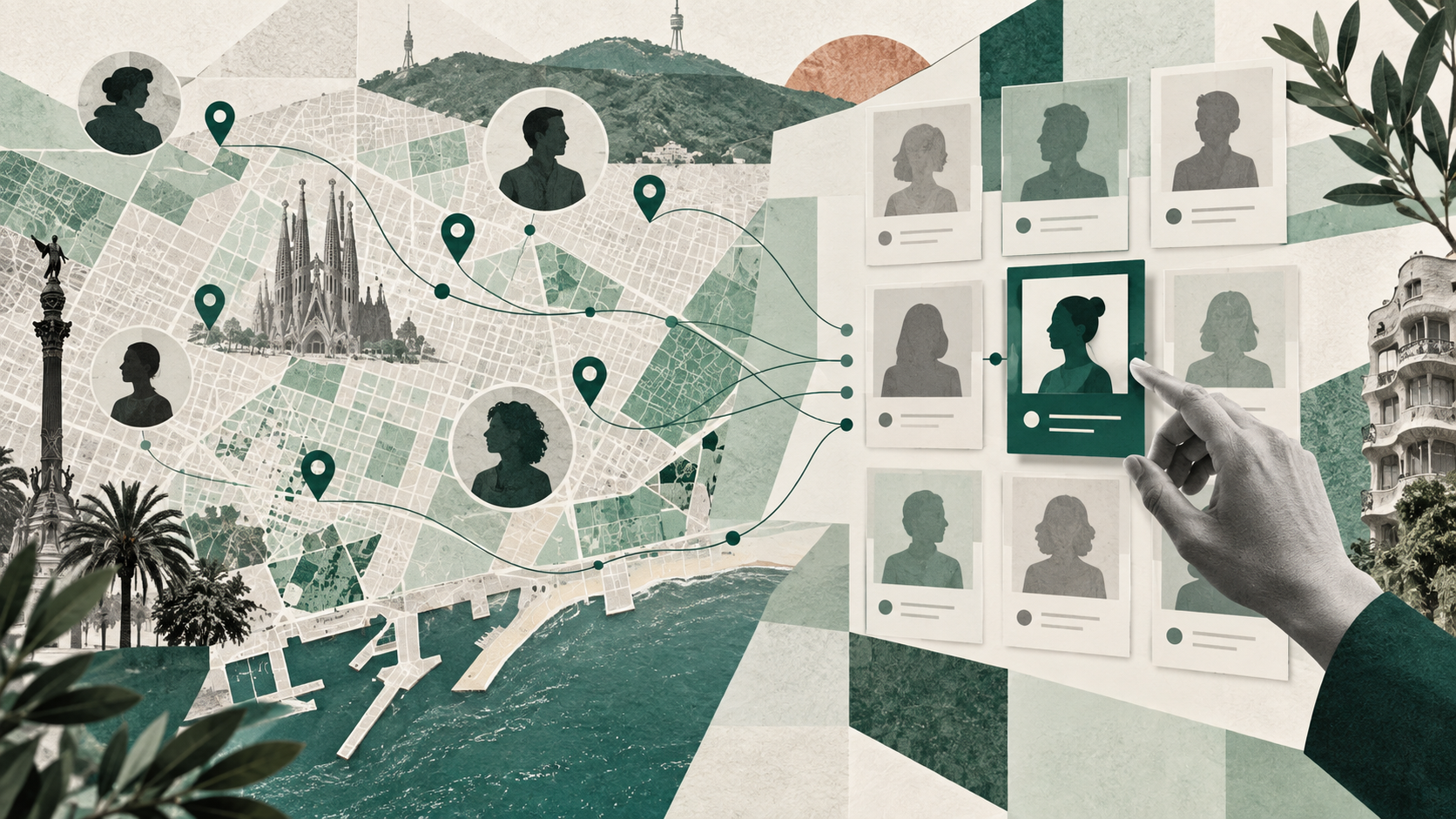
Finding a psychology professional is not an ordinary search. People are not simply looking for a name or address. They are trying to understand specialisms, approaches, formats, languages, location and contact options at a moment that may already feel difficult. This was the starting point for the Barcelona Psychology Directory ↗, a digital project that turns fragmented information into a clearer, searchable and more transparent guidance experience.
The result is a bilingual Catalan and Spanish website with a general directory, profile pages, specialisms, a map, methodology, editorial selections, content and services for professionals. Yet the project’s value does not lie in its number of pages. It lies in the system connecting them: structured data, editorial criteria, search architecture, identity, accessibility, technical SEO and governance that prevents the directory from presenting itself as a clinical ranking or making therapeutic promises.
It is a useful example of what AI websites mean at Karmina. Not a decorative layer or an automatically generated landing page, but a digital product where artificial intelligence helps organise, build and scale an architecture that still requires human judgement.
The problem: plenty of information, little guidance
Information about psychologists and centres exists, but it is usually fragmented. Some lives on individual websites; other parts appear in general directories, appointment platforms, maps or social profiles. Categories do not always match, data can become outdated and the same person may appear in several places with different descriptions.
The easy answer would have been to build a list. The useful answer required a different question: what does someone need in order to orient themselves before making contact?
From there, we defined an experience that can be explored by need, specialism, area, format and other relevant criteria without turning the process into an opaque classification. The directory does not decide who is “best” for each person. It organises information so a decision can be made with more context and so it is easier to reach the appropriate source or contact channel.
From a database to a service architecture
A directory is not a collection of cards. It is an architecture of relationships.
Every profile needs to coexist with specialism pages, locations, filters, a map, methodology and editorial content. Names must remain consistent. Routes cannot be duplicated. Language changes must lead to the equivalent version. Generated pages need to remain connected to the directory rather than becoming islands created only to attract traffic.
We therefore designed the project in layers:
- A general directory for broad exploration.
- Individual profiles with useful information and contact routes.
- Specialisms and needs that bring professional language closer to the language used by people seeking help.
- A map and locations that add the territorial dimension.
- Methodology that explains sources, criteria and limits.
- Guides and content that answer questions before a decision.
- Services for professionals because the project also understands the sector’s digital needs.
The public sitemap contains more than a thousand routes. This scale was not solved by writing isolated pages. It required models, components and rules that let every element maintain a coherent structure.
Bilingual means two editorial experiences
The project needed to work in Catalan and Spanish. Translating a menu was only a small part of the challenge.
Each language needs its own routes, natural copy, correct metadata, equivalent links and clear signals for search engines. Pages use distinct URLs, language labels, reciprocal links and a language switch that leads to the corresponding content. This prevents versions from becoming mixed, journeys from being duplicated or incorrect addresses from being generated.
We also worked on the difference between translation and localisation. Someone may search for a psychologist in Barcelona, a particular specialism, a neighbourhood or a specific problem. The underlying information can be shared, but the wording, expressions and search intent need to feel natural in each language.
Trust without promising more than we know
In mental health, the quality of a directory depends as much on what it displays as on what it refuses to claim.
The project does not show invented star ratings, promise therapeutic results or sell positions as if they were clinical recommendations. When a page discusses editorial selections or “best” professionals, the criteria must be visible, editorial and open to review. A verification label cannot mean more than what has actually been checked.
This boundary shaped both methodology and language. Identity, self-declared information, data from a public source, membership of an organisation and editorial verification are different things. Professionals and centres also need a route to report errors, request updates or ask for removal.
AI can help detect inconsistencies, normalise fields or prepare content. It cannot turn incomplete data into certainty. In this project, judgement is not a final review added to the process. It is part of the architecture.
An institutional identity designed for consultation
Visually, we avoided premium-clinic codes, wellness aesthetics and predictable brain or heart symbols. The identity uses white, black, greys, a confidence green and a restrained earth accent. Typography prioritises reading and hierarchy, using an editorial register only when it adds context.
The decision follows the nature of the product. A psychology directory should communicate calm and rigour, but above all it must be easy to use. Filters need to be understandable, focus visible, controls large enough, forms clear and navigation usable on mobile, with zoom and with a keyboard.
Accessibility was not treated as an appendix. It influenced colours, sizing, labels, contrast, errors, states and reading order. When a website guides people in a health context, reducing friction is also a form of responsibility.
How we used AI
AI accelerated important parts of the process: initial structuring, normalisation, preparation of content variants, consistency review and checks across hundreds of routes. It also made it possible to iterate more quickly on components, metadata and copy.
That acceleration only worked because a decision system already existed. Before generating anything, we needed to define what a profile was, which fields were required, what each status meant, which pages should be indexed, how languages were connected and which claims were unacceptable.
This is the combination that matters to Karmina: AI expands execution capacity, while people define the judgement, validate the boundaries and assume responsibility.
What we learned
The project leaves us with five transferable lessons:
- A directory is a data product. Its interface is only reliable when the underlying model distinguishes people, centres, locations, specialisms and sources.
- Scale needs rules. Generating many routes is easy; maintaining coherence, usefulness and quality is the real work.
- Trust must be visible. Methodology, sources, dates and correction routes are not legal footnotes. They are part of the experience.
- Localisation is architecture. Languages affect content, navigation, metadata and relationships between pages.
- AI adds more value when judgement is already defined. Without an editorial and governance model, it only accelerates inconsistency.
The Barcelona Psychology Directory ↗ is a public website and an applied laboratory for building complex consultation platforms with data, content, design and AI. This learning —not only the code— is what we can bring to new directories, sector portals and digital ecosystems for our clients.