KarminaAI StudioAgents · Services · Training





Content & Channels · AGENT-A01
Social Publisher
This landing page explains what automates Social Publisher, what sources and tools you need, how the result is reviewed and how it can be applied within a company.
StrategyOwn knowledgeProportional permissionsHuman supervisionMeasurement and improvement
01
The agent, at a glance
What Accelerates
Topic detection, preparation of first drafts, multi-channel adaptation, format variants, assisted programming and reuse of existing content.
What does it deliver
Pieces prepared by channel, date and target proposal, source of origin, variants, labels, links, necessary resources and notices on what has yet to be validated.
For whom it is
Social media, communication, content and marketing teams that manage various channels, brands or markets and need to produce more continuously without diluting the criteria.
What it doesn't do
It does not invent positions, does not convert any trends into content, does not use rights-free materials and does not automatically publish what the brand policy obliges to review.
02
The problem it solves
Posting more does not help if each piece starts again from a blank page
Information exists: presentations, articles, reports, campaigns, meetings, customer questions and team ideas. The problem is to transform it in a sustained way into useful content for channels with different languages, rhythms and limitations.
When this process depends only on memory, urgency and manual copying, known frictions appear:
- The calendar fills up late and with too many reactive pieces.
- The same idea is copied between channels without adapting the angle.
- The voice varies depending on who is writing or the pressure of the moment.
- Data or messages that are no longer valid are reused.
- It is hard to know where a claim comes from or who has validated it.
- The team devotes time to mechanical variants and loses time to think the story.
- Programming and publishing become a bottleneck.
The Social Publisher turns this production into a visible, repeatable and reviewable circuit.
03
What exactly is Social Publisher?
It is a content agent that receives a specific editorial mission, consults the allowed knowledge and transforms approved entries into structured social proposals.
It doesn’t just work with a “write a post” type of instruction. It needs to know what role each channel has, who it speaks to, what publishing territories are priorities, what terminology should be used, what claims require evidence, what cannot be published and who approves each type of piece.
You can prepare content and, when the policy allows, schedule or publish it. Autonomy is not a fixed property of the agent: it is defined by content type, channel, risk and maturity of the process.
04
What do you do, specifically?
01. Turn sources into editorial opportunities
It retrieves ideas from documents, selected news, articles, videos, frequently asked questions, campaigns or other authorized sources and orders them according to the territories and objectives of the brand.
02. Prepare the Mother Piece
Define angle, central message, public, call to action, evidence and resources before multiplying versions.
03. Adapted by channel
Rewrites the piece to match the conventions, length, level of context and role of Threads, Bluesky, X, LinkedIn or the agreed channels. Adapting is not cutting: it is preserving the intention with an appropriate form.
04. Generate useful variants
You can prepare a main version, a shorter alternative, a thread, a question, a continuity answer or a proposal to reuse the topic at another time.
05. Apply brand and risk criteria
Checks voice, terminology, assertions, links, rights, mentions, accessibility and documented restrictions. When he detects a doubt, he does not fill it with an assumption: the mark.
06. Prepare the programming
It proposes channel, date, time, campaign, labels and review status. You can take the piece to the calendar tool if you have the necessary permission.
07. Keep the Trace
It relates each publication to the source, the briefing, the approved version and the person responsible so that the process can be reviewed and learned.
DUBTE BACK
You don’t have to know which agent you need.
Let’s start with a repeated task, the sources available and the result you want to review. In a free video call we can assess if you need an agent, a service or simply better order the process.
Video call · free · no obligationBook a free video call ↗A short conversation to understand your starting point and bring clarity.
05
How it works from start to finish
- Get the activation. It can start from a briefing, a new source, a pending calendar or an opportunity approved by the Social Listener.
- Check the context. Verify that there is objective, channel, public, source, validity and responsible.
- Check the Social Media OS. Retrieves voice, territories, formats, restrictions and validated examples.
- Prepare the mother proposal. Structure the message before generating versions.
- Adapt and check. Create the pieces, apply the controls and point out gaps or risks.
- Send to Human Gate. The team reviews the pieces that need it and decides what is approved.
- Program or leave prepared. Act only within the agreed permissions.
- Record the decision. Save sources, changes and approvals so the system can improve.
06
Example of situation
A report can feed a week of content without becoming seven copies.
The organization publishes its own study. The Social Publisher receives the final document and the official page. First it identifies the approved conclusions, the data that can be cited and the nuances that should not be lost.
From there, it prepares a main piece for LinkedIn, a short thread for X, two conversational posts for Threads and Bluesky, and a list of questions the team can use to keep the conversation going. Each proposal retains the link to the source and the audience to which it is addressed.
If a data does not match between the PDF and the web page, the agent does not silently choose a version: it stops the affected piece and asks the person responsible to confirm what the current source is.
07
What do we need before we launch it?
Essential
- Function and priority of each channel.
- Publics and publishing territories.
- Voice guidance, terminology and sensitive messages.
- Sources that can be used and criterion of validity.
- Permitted, conditioned and prohibited content types.
- Review circuit, responsible and deadlines.
- Publication policy, access and credentials.
Highly recommended
- Examples of approved and rejected pieces.
- Editorial calendar and active campaigns.
- Resource library with rights information.
- SEO/GEO criteria for profiles, entities, questions and links.
- Performed performance history, not just gross metrics.
If it does not yet exist
Karmina can build this layer inside the Social Media OS. The agent should not invent the voice or editorial plan that the organization has not yet decided.
08
How we implant it
- Current Circuit Diagnosis: fonts, calendar, channels, people, tools and frictions.
- Foundation editorial: See, territories, criteria, permissions and examples.
- Design of missions: which pieces you can prepare, schedule or publish.
- Pilot Controlled: A set of sources, channels, and real content.
- Tests: coherence, fidelity, accessibility, rights, errors and time saved.
- Onboarding: use, correction, escalation and responsibilities.
- Evolution: New channels or more autonomy only when the evidence justifies it.
A REAL TASK IS THE BEST BRIEF
Explain where the friction is concentrated.
You can send us an example, the approximate volume and how it is reviewed today. No need to share sensitive data to make a first assessment.
09
Human supervision and boundaries
The agent can
- Prepare and adapt content.
- Consult authorized sources.
- Suggest schedule and reuses.
- Apply documented checks.
- Schedule or publish low-risk items when express authorization exists.
Agent can't
- Create a corporate position on an unapproved issue.
- Make claims without a valid source.
- Use personal data or materials without purpose and permission.
- Respond to crises, claims or sensitive situations as if they were ordinary content.
- Post outside of assigned channels, part types and limits.
Stop and scale when
There are conflicting sources, a given cannot be verified, the subject is sensitive, rights are lacking, a crisis appears, the calendar conflicts with a recent decision or the piece requires a voice that is not documented.
10
Sources and possible connections
You can work with the Social Media OS, brand guides, calendars, blogs, websites, newsletters, document repositories, asset libraries and social management tools. It can also connect with the Social Listener, the Brand Guard, the Karmina Review Agent and the Dashboard Builder.
Specific connections depend on the client’s tools. It always starts with the minimum necessary accesses and, when possible, with test environments or draft states.
11
How do we measure if it adds value?
- Time between approved source and first useful draft.
- Percentage of pieces approved with minor changes.
- Reduction of voice, data, links or format errors.
- Time dedicated by the team to mechanical adaptations.
- Coverage of priority territories and channels.
- Percentage of content with traceable source and version.
- Incidences of publication and correct scaling.
- Ability to reuse knowledge without literally repeating the pieces.
Success is not publishing anymore by default. It’s sustaining a more consistent presence with less friction and more control.
12
For whom does it make sense?
It can fit if
- There is a social strategy that is difficult to apply continuously.
- The team manages various channels, languages, brands or markets.
- There are many profitable sources but little capacity for transformation.
- The publication depends on repetitive variants and scattered approvals.
- You want to start with drafts and gradually move towards more automation.
It’s not the first step yet.
- It is not defined why each channel exists.
- There is no voice or minimal editorial territory.
- Sources are obsolete or no one assumes ownership.
- The main problem is not the production but the lack of strategy.
In these cases, the first recommended project is the Social Media OS.
DUBTE BACK
You don’t have to know which agent you need.
Let’s start with a repeated task, the sources available and the result you want to review. In a free video call we can assess if you need an agent, a service or simply better order the process.
Video call · free · no obligationBook a free video call ↗A short conversation to understand your starting point and bring clarity.
13
Knowledge Foundation and adoption
The Social Publisher needs a governed editorial base: strategy, voice, publics, territories, sources, examples, rights, calendar and scaling rules. Each layer must have an owner and an update criterion.
During onboarding, the team learns to activate the agent, interpret the warnings, correct a piece without messing up the system, and distinguish between a point error and a rule that needs to be updated.
14
Frequently Asked Questions
Can you post directly?
Yes, but only the content types, channels and authorized situations. Many organizations begin with drafts or pending programming approval.
Does it only work for X, Threads and Bluesky?
No. These channels are a natural starting point for their frequency and textual structure, but can be adapted to other networks with their own criteria.
Replace the editorial calendar?
No. He consults and executes. If the schedule or strategy does not exist, they need to be built first.
Can you create content from news?
It can follow approved sources and prepare proposals, but a news story does not automatically become an opportunity. Contrast, relevance and fit.
Can you reply to comments and messages?
Only if a specific circuit is incorporated. Management of tickets and care is better dealt with Inbox Flow or Support Desk.
How do you keep it updated?
Sources, voice, campaigns, and restrictions have owners and review dates. Maintenance can remain within the team, be shared or be part of Always-On Social.
How much does it cost and how long does it take?
It depends on the channels, sources, integrations and level of autonomy. The proposal is sized after a brief diagnosis and begins with a scope that can be tested.
15
Closure and conversion
What is the most time-consuming part of social production without providing more criteria?
Explain to us how ideas happen today on the calendar, who adapts the pieces, what sources are used and where errors or waits appear. We will evaluate if the Social Publisher is a good first agent or if it is convenient to start by the editorial system.
Direct contact hello@karmina.ai
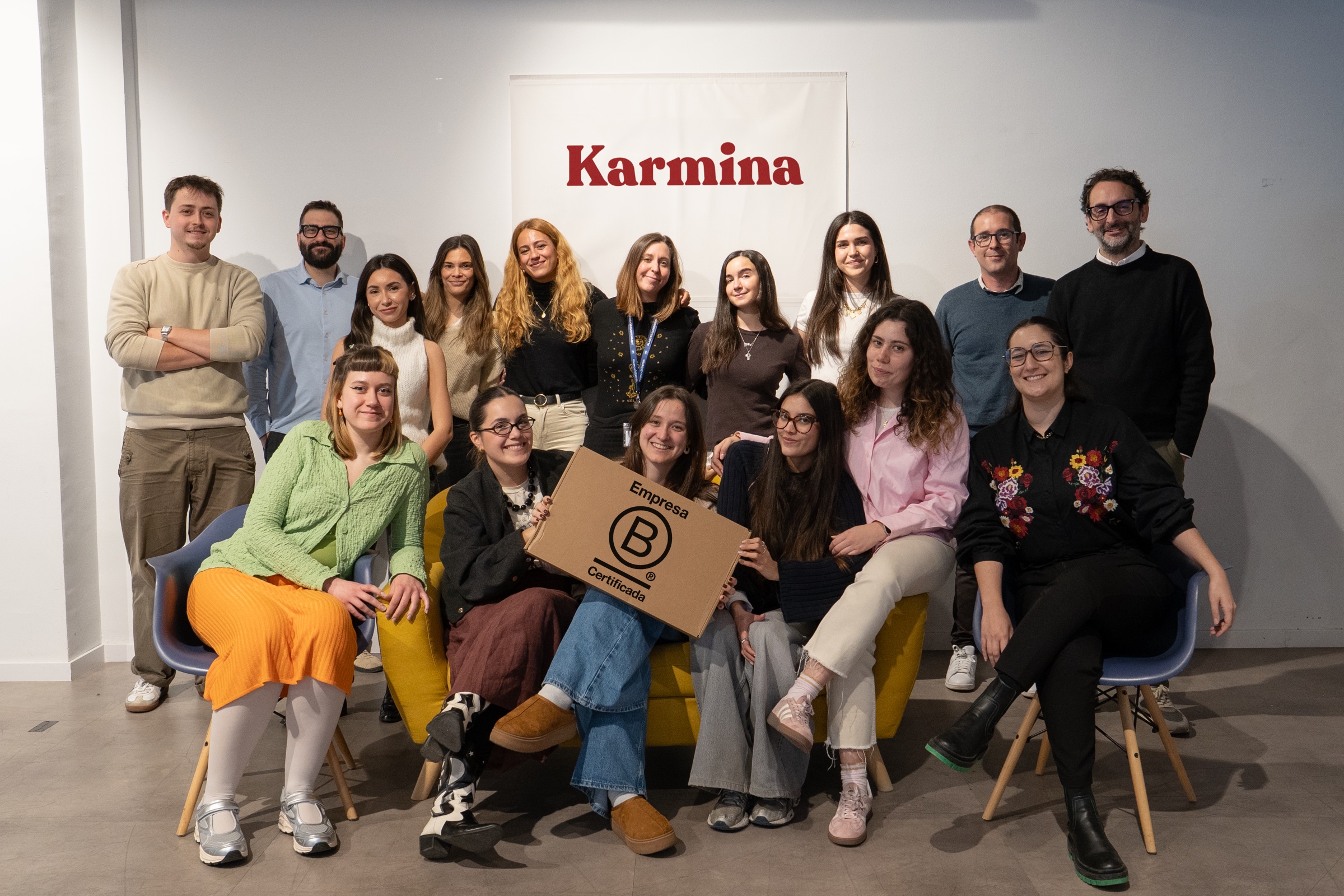
Karmina, the agency behind the Studio
Why Karmina?
Behind Karmina AI Studio there is an agency with track record, team, scale and applied experience in real organizations.
Karmina · AI Studio · Criterio · Dunder Mifflin · Utopiq · Smart Team
 +€119mIn advertising investment for clients
Ads Platforms
Partners MetaGoogle Ads
 TikTok
 Pinterest
 Barcelona
Madrid
Buenos AiresOur offices · Meet the team ↗
+50 KCommunity
 B CorpCertified company
The team
People who connect knowledge and practice


Arnau Sanz
Agentic Strategy & AI Transformation Lead

Ignasi Llorente
AI Partnerships & Business Director

Martina Díaz
AI Finance & Business Intelligence Director

Daniel Mallén
AI Operations & Workflow Lead

Eva Trigo
Generative Creative Director

Ariadna Miranda
AI Administration & Knowledge Operations Lead

Claudia Gonzalez
AI Client Success Manager

Jonan Basterra
AI Social Strategy Director

Laura Sabio
Agentic Social Media Lead

Agustina Córdoba
Content AI Specialist

Alba Gómez
Social Listening Specialist

Paola Cudeiro
AI Client Success Specialist

Roger López
AI Project & Workflow Specialist

Mar Berzal
AI Content Strategy Lead

Andrea Gallego
Community Intelligence Specialist

Candela de la Fuente
Content AI Specialist

Blanca Gómez
AI Community Operations Specialist

Cintia Armajach
Content AI SpecialistLet’s talk
Let's talk about Social Publisher
Tell us about your situation, even if the challenge is not fully defined. A member of our team will respond to understand the process and discuss a first step.
hello@karmina.ai