


Management and business
Vision, objectives, sponsor, business plan, investment criteria and indicators to decide what goes on and what stops.
STRATEGIC CONSULTATION · PLA AI DIRECTOR
A process of direction, governance and adoption to align the entire organization: from business opportunity and internal knowledge to tools, risks, training and execution.
With a limited first phase of 3–Z6 months when scope allows.
NOT A DOCUMENT TO ARCHIVE
When each person tries a tool, the speed seems to progress. But without shared criteria appear duplicate licenses, fragmented knowledge, data out of control and use cases that nobody knows how to prioritize.
The Master Plan turns this dispersed movement into a business capacity: a common vision, justified technological decisions, clear responsibilities, trained teams and a portfolio of initiatives that can go from idea to execution.
This is what the plan calls for. Not by banning experimentation, but by turning it into shared learning.
Management stops seeing a collection of evidence. Technology ceases to receive isolated demands. Teams know what they can do, with what, with what data and when they should ask for help.
BEFORE YOU CLOSE ABAST
We can review the challenge, starting point and priorities in a free video call. Putting order before writing the scope usually saves time and budget.
A TRANSVERSAL LOOK
Business, technology, people, legal, data, communication and operations must be able to look at the same map, even if they do not make the same decisions.
Vision, objectives, sponsor, business plan, investment criteria and indicators to decide what goes on and what stops.
Audit of frictions, portfolio of opportunities, prioritization and tokens so that an idea is no longer just a promise.
Sources with authority, responsibility, permissions, validity and an architecture so that knowledge can be consulted and maintained.
Committees, roles, registration, Human Gates and approval circuits so that the responsibility is not diluted.
Map and matrix of risks, impacts, transparency, data protection, incidents and controls proportional to each use.
Objective architecture, licensing policy, purchasing criteria and selection of tools without dependence on a specific brand.
Literacy, role training, Ideathon, communication, internal referents, support and follow-up after launch.
A Master Plan doesn’t just say what we’re going to do with the AI. Make it clear who can propose it, who validates it, with what knowledge, what risk we assume and how we will know if it works.
IT'S FOR YOU IF...
DELIVERY MULTS. ONE SYSTEM.
We do not release an entire generic list by inertia. We define which pieces the organization needs, in what order and who will have to maintain them.
To turn ambition into decisions that can be defended in front of direction.
Because every use has owner, limits, control and a response if something fails.
To choose an architecture that works with real knowledge and does not leave it scattered.
Because the Plan changes behaviors, activates teams and continues to live after presenting it.
CHOOSE TECHNOLOGY IS ALSO STRATEGY
Identity, security, data, purchases, knowledge, permissions, registration, support and risk criteria.
Models, suites, automation or specialized tools are compared according to need, integration, total cost and internal capacity.
An exception may make sense. Must have owner, permit, review, expiration date and exit plan.
an approved catalog, a licensing policy, and a clear door to ask for exceptions.
Explore the Toolkit ↗KNOWLEDGE · THE FIL THAT CONNECTS IT
The Plan identifies the sources that have authority, who holds them, who can see them, when they expire, and what gaps prevent them from moving forward. This layer of Knowledge Foundation prepares the architecture of the Karmina Company Brain.
Knowledge is not an annex to the Plan. It is the infrastructure that allows people, tools and agents to work with the same reality.
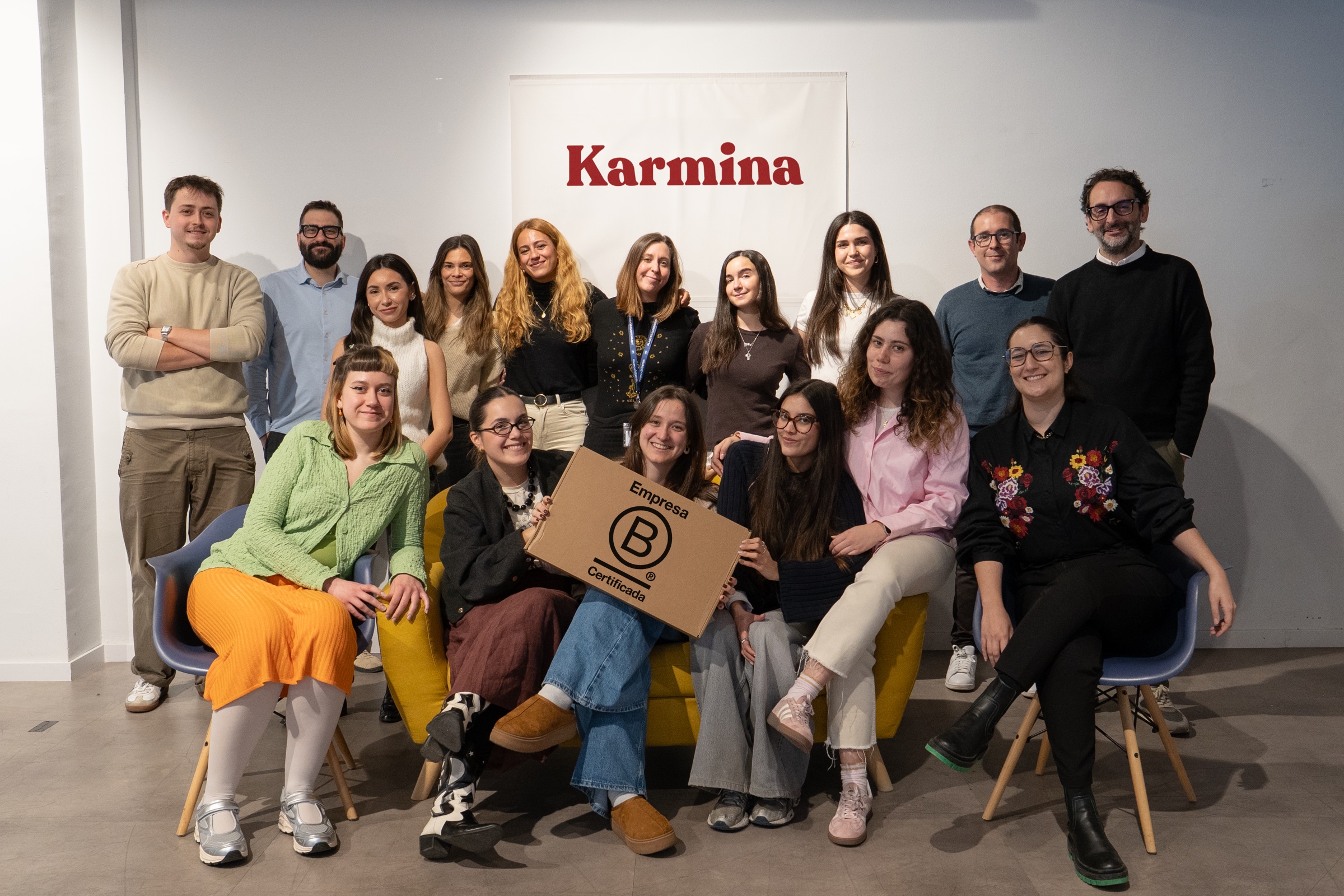
Karmina, the agency behind the Studio
Behind Karmina AI Studio there is an agency with track record, team, scale and applied experience in real organizations.
Karmina · AI Studio · Criterio · Dunder Mifflin · Utopiq · Smart Team
 +€119mIn advertising investment for clients
Ads Platforms
Partners MetaGoogle Ads
 TikTok
 Pinterest
 Barcelona
 B CorpCertified company
IF YOU ALREADY HAVE MATERIAL
It can be a finished document, a few notes or an email with context. We will read it before proposing a conversation or a first step.

IDEATHON · FROM PROBLEM TO DECISION
The idea comes after a previous base. It can convene a selection of departments, managers and operational profiles. Thus, ideas are born with knowledge of the process and can proceed to execution.
Interviews, audits, data and real frictions. Let’s not start with a rain of blank ideas.
Teams from different areas reshape challenges, contrast value, risk and feasibility, and propose concrete answers.
Each proposal comes with owner, next step and fits: training, tool, agent, service, pilot or discard.
TAKER · SHAPER · MAKER
The map helps to not build more technology than necessary and to decide what should come out of the Ideathon.
A team can solve the problem with existing tools, approved, well configured and with clear criteria of use.
Possible exit · Training + ToolkitIt is necessary to connect a tool with the process, sources, rules and supervision of the organization itself.
Possible exit · Service + integrationThe case justifies agents, automations or own architecture because there is sufficient knowledge, volume, risk and value.
Possible exit · Agent + governed systemA 6–12 MONTH SERVICE
In 3–6 months, a clearly scoped project can be completed and key decisions established. When a project spans departments, includes activation and aims to demonstrate adoption, the typical timeline extends to 6–12 months.
Sponsor, motor team, objectives, access to information and success criteria.
Audits, interviews, surveys, inventory of uses and reading of risks, knowledge and skills.
Common training, interdepartmental work and prioritization of problems that deserve an answer.
Governance, principles, technology, portfolio, training, communication, budget and roadmap.
Pilots, selection of tools, agents or services, onboarding, metrics, review and adjustment of the Plan.
SCHOOL EXPERIENCE
From around 50–100 people, when there are enough departments, decisions, tools and dependencies for coordination to deliver clear value.
A RED LINE
Productivity matters. They also matter the margin, speed and efficiency. But a Responsible Management Plan decides what we will do with the capacity that is released: improve quality, better care, reduce risk, innovate, grow or return time to the teams.
The purpose is not a phrase at the beginning of the document. It is seen in the budget, in the use cases that are prioritized, in the indicators and in the decisions that the company refuses to automate.
A CASE THAT MAKES THE METHOD TANGIBLE
Terrassa City Council’s AI Master Plan 2026–2028 shows how a complex organisation can move from scattered uses to a shared policy. Context is public; work logic is applicable to any organization that needs to align people, processes, knowledge, technology, and governance.
Read the full case ↗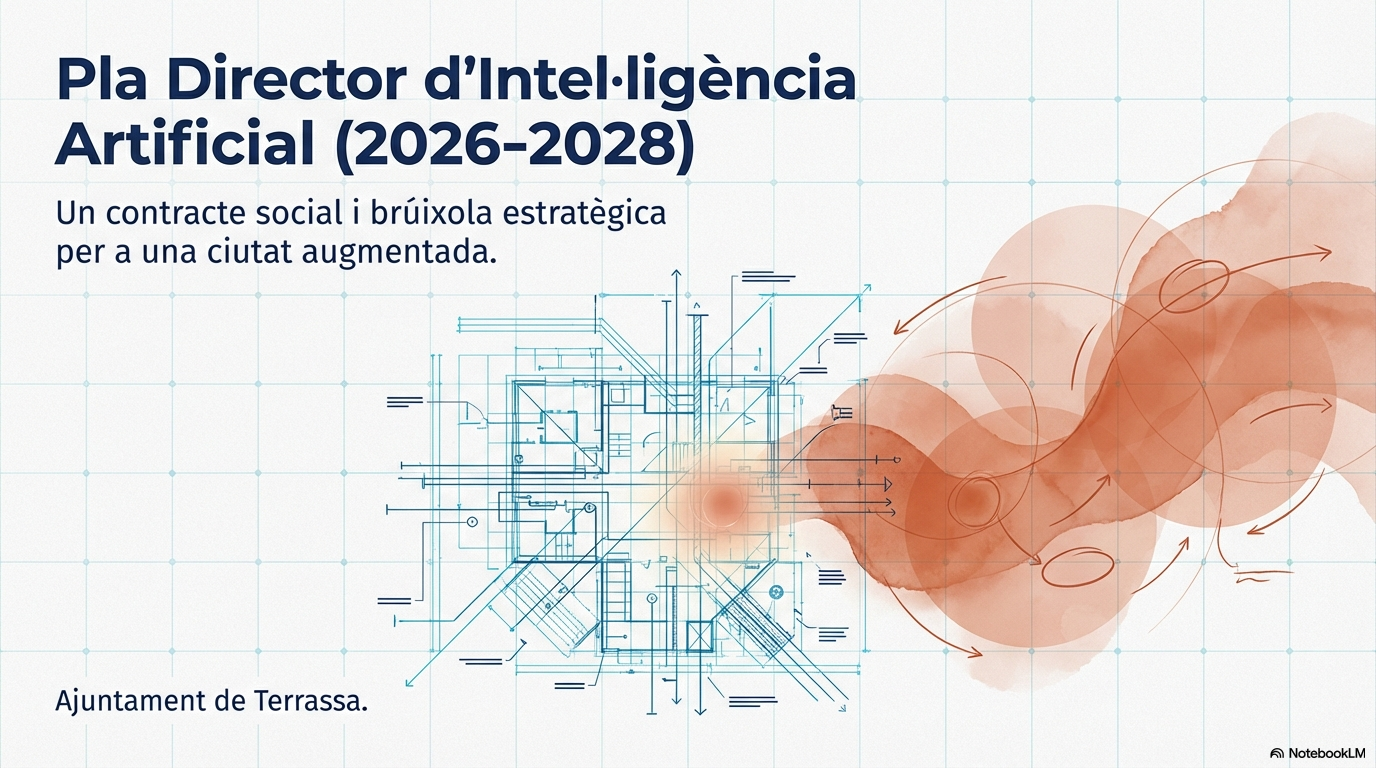
A master plan doesn’t have to tell everyone what tool to open. It must make clear what we want to transform, what decisions we will make in common and how we will turn real problems into initiatives with responsibility, risk and follow-up.
REFERENCE BRAND
The design of the Plan translates frameworks such as the European AI Act and the NIST’s AI Risk Management Framework into decisions, roles, training, records and controls that the organization can apply.
AI Act · Article 4 on ↗ literacyNIST AI RMF · Government, Map, Measure, Manage ↗Let’s talk about the master plan.
Tell us the size of the organization, the current uses and what a Master Plan has made you think. We will help you to assess if this is the right service or if it is convenient to start by training or a more limited phase.
hello@karmina.aiFAQS · STRATEGY AND KNOWLEDGE
It is the framework that orders the adoption of the AI for a certain period. It includes vision, principles, diagnosis, use case portfolio, knowledge and technology architecture, training, governance, budget, roadmap and indicators.
It makes sense when several areas already experiment with AI, there are shared budgets or risks or management wants to move from testing to organizational capability. Also before a large investment in platforms.
It is necessary to organize objectives, principles, current situation, contracted tools, critical knowledge, skills, risks and initiatives. Common definitions must also be resolved: what counts as a use case, pilot or system in production.
Investment includes diagnosis, governance, knowledge, platforms, integrations, pilots, training and maintenance. It should be expressed by stages and phases, with conditions to continue, stop or rethink.
It should be reviewed periodically and when regulations, suppliers, priorities or architecture change. The document must be alive, but the changes must be traced and approved.