KarminaAI StudioAgents · Services · Training





Content & Channels · AGENT-A02
Blog Publisher
This landing page explains what automates Blog Publisher, what sources and tools you need, how the result is reviewed and how it can be applied within a company.
StrategyOwn knowledgeProportional permissionsHuman supervisionMeasurement and improvement
01
The agent, at a glance
What Accelerates
Initial research within approved sources, structure, first draft, formal review, metadata, internal linking, adaptations and loading to CMS.
What does it deliver
An article with objective, public, structure, sources, title and subtitles, metadata, links, pending resources and clear editorial status.
For whom it is
Content teams, communication, SEO, thought leadership and marketing who have valuable knowledge but difficulty in turning it into a sustained editorial production.
What it doesn't do
It does not publish baseless claims, does not fabricate experiences, does not plagiarize sources, does not decide the opinion of the organization and does not convert word volume into quality.
02
The problem it solves
The bottleneck is not writing. Find a book that is worth publishing.
Many teams accumulate topics, presentations, reports, interviews and experience, but the articles do not advance because the process is split between too many hands and tools. Research does not reach the writer, SEO comes in late, reviewers do not know what to check, and uploading to the CMS is left until the end.
The result is usually one of two extremes: articles that take too long to come out or fast, generic and interchangeable texts.
The Blog Publisher commands the complete run:
- It turns an editorial need into a clear question.
- Regain existing knowledge before looking outside.
- Separate facts, interpretations and claims that need to be validated.
- Apply a consistent structure with the intent of search and business.
- It keeps the institutional or personal voice defined.
- Prepare the draft within the actual review circuit.
03
What exactly is Blog Publisher?
It is an editorial production agent connected to a knowledge base, a content system, and a publishing flow. It can intervene from briefing to the draft loaded into CMS, with Human Gates different according to the type of article.
An article of service, a piece of opinion, a practical guide and a success case do not need the same circuit. The agent works with templates, sources, managers and criteria adapted to each format.
Its function is to reduce repetitive work and prevent knowledge from being lost between documents; its function is not to substitute authorship or present an automatic synthesis as if it were one’s own experience.
04
What do you do, specifically?
01. Turn the idea into a full briefing
Define public, main question, intention, value proposition, angle, expected action and limits before drafting.
02. Investigate within authorized sources
Recovers documents, data, statements, cases and previous content. Point out gaps and ask for missing information instead of filling them with generalities.
03. Prepare the architecture of the article
It proposes title, subtitles, plot order, questions to be answered, visual resources and connections with other pages.
04. Writing with voice and evidence
It generates a first draft that differentiates the verifiable facts from the interpretation and preserves the necessary sources to review each claim.
05. Incorporates SEO, AEO and GEO naturally
Prepare metadata, internal linking, suggested structured data, frequently asked questions, and relevant entities without converting the text into a keyword stack.
06. Prepare the Review
It points out sensitive claims, snippets pending approval, date data, image rights and editorial decisions.
07. Load Draft
When you have the proper permission, create or update the entry in draft state, apply the structure, links and metadata and leave the piece ready for final review.
08. Reuse without duplicating
Derived extracts for social, newsletter, FAQs or commercial resources, maintaining the relationship with the mother article.
DUBTE BACK
You don’t have to know which agent you need.
Let’s start with a repeated task, the sources available and the result you want to review. In a free video call we can assess if you need an agent, a service or simply better order the process.
Video call · free · no obligationBook a free video call ↗A short conversation to understand your starting point and bring clarity.
05
How it works from start to finish
- It activates a theme. The team brings a question, a campaign, a source or an opportunity.
- The briefing is validated. The agent checks objective, public, format, responsible and date.
- The source package is built. Retrieves internal knowledge and, if allowed, external research.
- The structure is proposed. A person can validate the angle before the full text is written.
- The draft is generated. The agent writes with citations, links, and review markers.
- Controls are applied. Voice, SEO, affirmations, rights, accessibility and coherence with existing content.
- It is sent for review. The author or publisher approves, corrects or requests a new version.
- The CMS is loaded or updated. Always in the state allowed.
- Learning is recorded. Useful fixes update criteria, not just that article.
06
Example of situation
An internal interview ceases to be an archive and becomes a piece of authority
An expert from the organization participates in a meeting about a change in the sector. With authorization, Meeting Notes prepares a transcript and separates ideas, examples, and statements that need verification.
The Blog Publisher crosses this material with the official documentation selected, proposes an angle, structures a guide and marks which phrases should be attributed to the expert. It also detects an old article that should be updated to avoid contradictions.
The editor validates the point of view, reviews the data and approves the final version. The agent creates the draft in CMS and prepares two social pieces. It does not turn the conversation into a public appointment without consent or complete with opinions that the interviewee has not expressed.
07
What do we need before we launch it?
Essential
- Editorial strategy and objectives.
- Publics, priority topics and type of article.
- See, terminology and criteria of authorship.
- Permitted internal and external sources.
- Dating policy, links, rights and content assisted by AI.
- Flow of approval and publication status allowed.
- Delimited access to CMS if there is automatic charging.
Highly recommended
- Inventory and audit of existing content.
- Map key words, questions and entities.
- Internal link architecture.
- Templates by type of piece.
- Examples of good and bad quality.
- Editorial calendar and expiration criteria.
If the base does not exist yet
The first step is to build one. Knowledge Foundation and a strategy of visibility. The agent should not use the CMS as a systemless text file.
08
How we implant it
- Diagnosis of the process and the editorial repository.
- Definition of formats, sources, authorship, SEO and approvals.
- Circuit design for a priority article type.
- Pilot with real contents and a draft environment.
- Loyalty tests, originality, appointments, links and rendering.
- Onboarding by editors, authors and managers of CMS.
- Gradual extension to new formats, languages or derivatives.
A REAL TASK IS THE BEST BRIEF
Explain where the friction is concentrated.
You can send us an example, the approximate volume and how it is reviewed today. No need to share sensitive data to make a first assessment.
09
Human supervision and boundaries
The agent can
- Synthesize approved sources.
- Propose angles and structures.
- Prepare drafts and metadata.
- Mark out contradictions or gaps.
- Create draft entries and apply authorized link.
Agent can't
- Invent appointments, clients, results or experiences.
- Present an opinion as an institutional position without approval.
- Extensively copy a source or hide its dependence.
- Publish sensitive or high impact content without the Human Gate set.
- Reuse personal data or materials outside of the authorized purpose.
Stop and scale when
The sources are contradicted, a data cannot be verified, the text deals with legal or reputational issues, there is an accusation, the consent of a cited person is missing, there is a risk of plagiarism or the CMS presents an unforeseen change.
10
Sources and possible connections
You can consult repositories of documents, websites, editorial guides, knowledge bases, authorized interviews, Search Console, tools SEO and CMS. You can connect with Meeting Notes, SEO Monitor, Brand Guard, Social Publisher and Review Agent.
The specific tools depend on the customer's ecosystem. By default, the upload is done in draft and with permissions limited to the required section.
11
How do we measure if it adds value?
- Time from briefing to a first reviewable draft.
- Percentage of articles that exceed editorial control without total rewriting.
- Quality and traceability of sources.
- Errors detected before publishing.
- Complying with the linking and metadata architecture.
- Percentage of content updated or reused meaningfully.
- Reduction of manual loading and formatting tasks.
- Evolution of organic performance interpreted in context, without attributing it only to the agent.
12
For whom does it make sense?
It can fit if
- There is knowledge and ideas, but it lacks editorial capacity.
- Recurring formats with a clear structure are published.
- The SEO, edition and CMS are all too separate.
- You want to expand the production without converting the blog into generic content.
- The team needs more traceability on sources and approvals.
It’s not the first step yet.
- There is no editorial strategy or priority questions.
- It is not possible to distinguish which documentation is valid.
- No one will take responsibility for editing and approving.
- The web needs an architecture or a migration of content first.
DUBTE BACK
You don’t have to know which agent you need.
Let’s start with a repeated task, the sources available and the result you want to review. In a free video call we can assess if you need an agent, a service or simply better order the process.
Video call · free · no obligationBook a free video call ↗A short conversation to understand your starting point and bring clarity.
13
Knowledge Foundation and adoption
The basis of Blog Publisher includes topics, public, voice, authorship, fonts, web architecture, SEO criteria, linking, rights, and expiration. Not all the base has to be complete on the first day, but the first pilot format does have to have enough criteria to be able to be evaluated.
The onboarding teaches you to build a good briefing, review claims, correct the agent with reusable criteria and keep the CMS without breaking the structure.
14
Frequently Asked Questions
Do you write the full article?
You can prepare a full draft, but the level of writing and review depends on the format. An opinion piece or success story requires more author involvement than an informative update.
Publish automatically?
He usually starts by creating drafts. Direct publishing is only valued for narrow, low-risk content and after sufficient testing.
Can you do external research?
Yes, if sources, contrast criteria and limits have been defined. External research does not replace the organization’s own knowledge.
How do you avoid duplicate content?
Check your editorial inventory, look for overlapping pieces, and may recommend updating, consolidating, or redirecting before creating a new URL.
Does it work for several languages?
Yes, but every language needs linguistic revision, voice, market, keywords and responsible. Translating is not always adapting.
Can you work with WordPress?
Yes, and also with other CMS when there is a viable access. The connection and permits are validated before the pilot.
How much does it cost and how long does it take?
It depends on formats, font volume, CMS, languages and integration level. It is sized after a diagnosis and tested first with a specific article type.
15
Closure and conversion
What important knowledge has not yet reached the web?
Explain to us how an article is born today, who provides the sources, who edits and where the publication is blocked. We will design a first circuit that protects the criterion and eliminates tasks that do not need to start from scratch.
Direct contact hello@karmina.ai
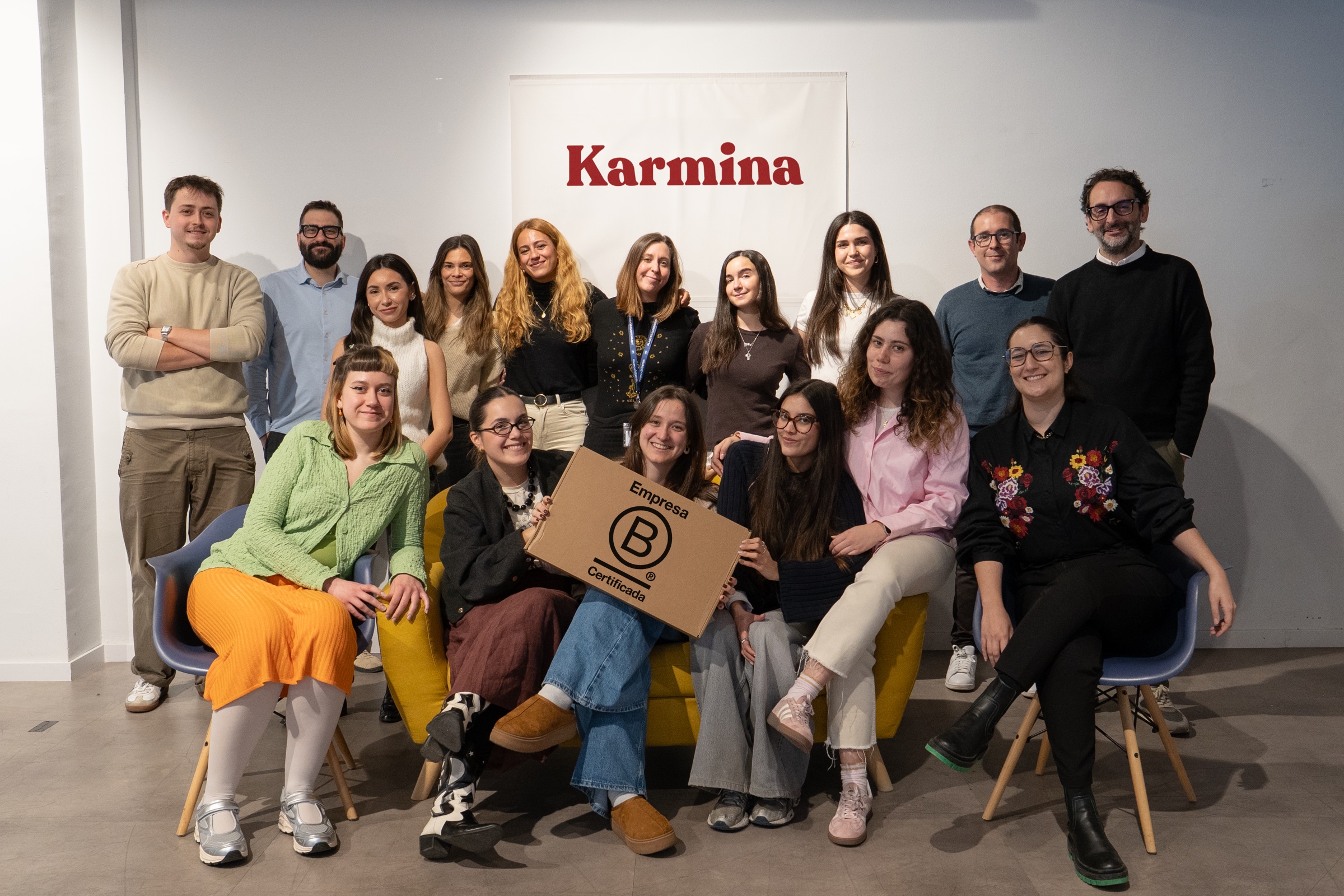
Karmina, the agency behind the Studio
Why Karmina?
Behind Karmina AI Studio there is an agency with track record, team, scale and applied experience in real organizations.
Karmina · AI Studio · Criterio · Dunder Mifflin · Utopiq · Smart Team
 +€119mIn advertising investment for clients
Ads Platforms
Partners MetaGoogle Ads
 TikTok
 Pinterest
 Barcelona
Madrid
Buenos AiresOur offices · Meet the team ↗
+50 KCommunity
 B CorpCertified company
The team
People who connect knowledge and practice


Arnau Sanz
Agentic Strategy & AI Transformation Lead

Ignasi Llorente
AI Partnerships & Business Director

Martina Díaz
AI Finance & Business Intelligence Director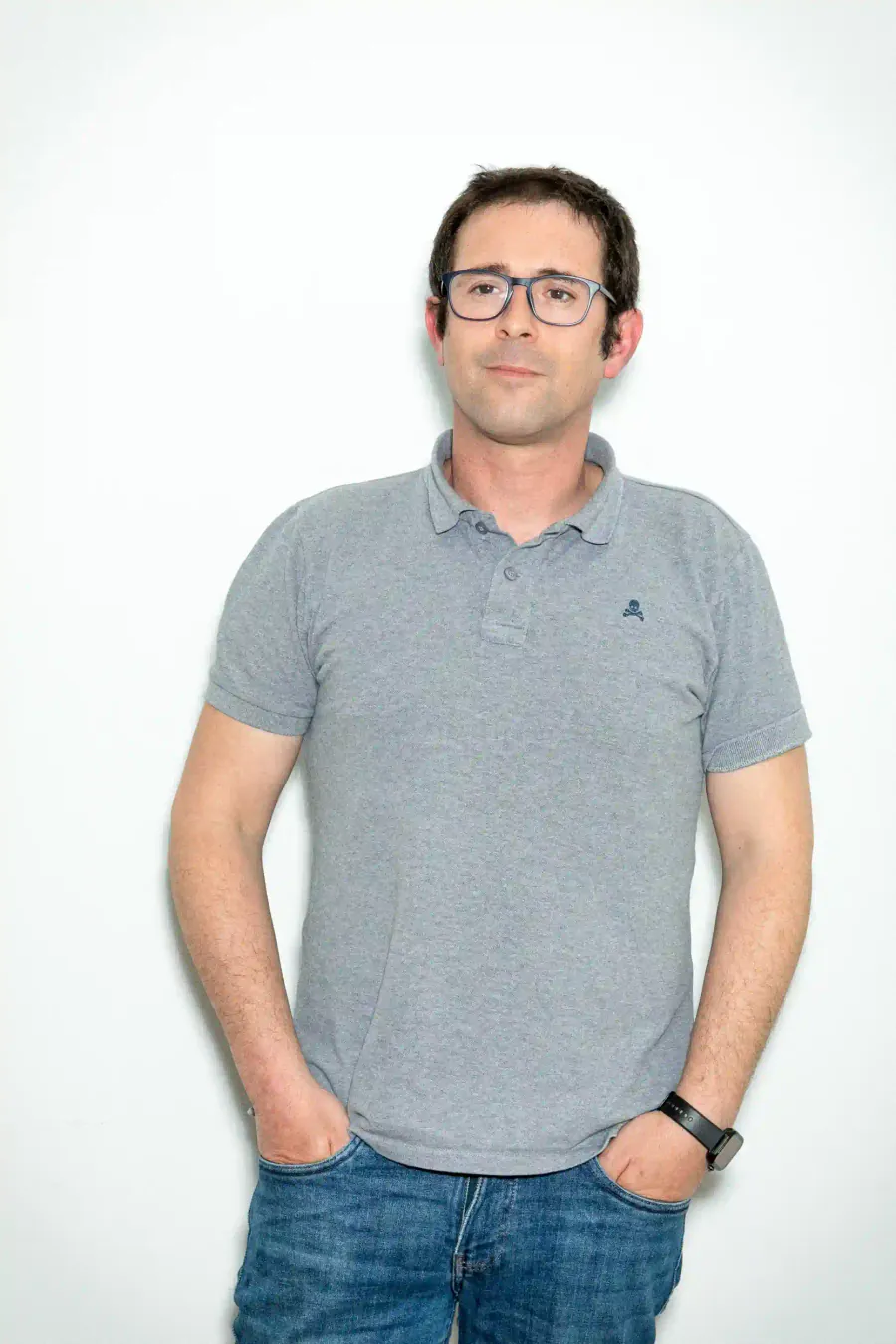

Daniel Mallén
AI Operations & Workflow Lead

Eva Trigo
Generative Creative Director

Ariadna Miranda
AI Administration & Knowledge Operations Lead

Claudia Gonzalez
AI Client Success Manager

Jonan Basterra
AI Social Strategy Director

Laura Sabio
Agentic Social Media Lead

Agustina Córdoba
Content AI Specialist

Alba Gómez
Social Listening Specialist

Paola Cudeiro
AI Client Success Specialist

Roger López
AI Project & Workflow Specialist

Mar Berzal
AI Content Strategy Lead

Andrea Gallego
Community Intelligence Specialist

Candela de la Fuente
Content AI Specialist

Blanca Gómez
AI Community Operations Specialist

Cintia Armajach
Content AI SpecialistLet’s talk
Let's talk about Blog Publisher
Tell us about your situation, even if the challenge is not fully defined. A member of our team will respond to understand the process and discuss a first step.
hello@karmina.ai