KarminaAI StudioAgents · Services · Training





Conversations & Support · AGENT-A18
Support Desk
This landing page explains what automates Support Desk, what sources and tools you need, how the result is reviewed and how it can be applied within a company.
StrategyOwn knowledgeProportional permissionsHuman supervisionMeasurement and improvement
01
The agent, at a glance
What Accelerates
Triage, FAQs, conditions consultation, guided steps, case creation, status updates and referrals.
What does it deliver
Response or action, source used, state of the case, minimum data, necessary history, responsible person and reason for the escalation.
For whom it is
Attention teams, services, product, e-commerce, training or operations with recurring queries and differentiable exceptions.
What it doesn't do
It does not resolve complex claims per template, does not promise compensation, does not make decisions that affect rights or contracts, does not hide limitations and does not use data outside the purpose of the case.
02
The problem it solves
A base of FAQs does not resolve support if exceptions arrive without context
Care teams waste time looking for procedures, asking for data that already exists and referring cases to people who have to reconstruct the entire conversation.
Support Desk reduces:
- Outdated answers.
- Incomplete derivations.
- Repeated queries on various channels.
- Simple cases that block complexes.
- Promises not authorized.
- Sensitive data collected without necessity.
- It lacks a clue as to what has been communicated.
03
What exactly is Support Desk?
He is a care agent connected to a service knowledge base and a case system. Every attempt has a policy: what you can answer, what data you can query, what action you can execute and when you need to transfer.
It can operate on web, mail, WhatsApp or other viable channels, but the service logic is shared and the rules of each channel are maintained.
04
What do you do, specifically?
01. Identify the need
It classifies the reason, priority and type of user without sensitive inferences.
02. Verify your identity when necessary.
Applies only the level of identification needed before displaying data or executing actions.
03. Retrieve the current source
Consult conditions, procedures, products, services and authorized states.
04. Resolve delimited cases
Answer FAQs, guide steps, or execute reversible actions when the policy allows.
05. Detect exceptions
Recognize claims, contradictions, sensitive data, vulnerable people or cases outside of policy.
06. Scale with Context
Prepares summary, data, checks made, expectation and reason for transfer.
07. Learning from validated resolutions
Identifies new recurring cases, but only updates the basis after the approval of the person responsible.
DUBTE BACK
You don’t have to know which agent you need.
Let’s start with a repeated task, the sources available and the result you want to review. In a free video call we can assess if you need an agent, a service or simply better order the process.
Video call · free · no obligationBook a free video call ↗A short conversation to understand your starting point and bring clarity.
05
How it works from start to finish
- Ask them and tell them about the channel.
- It classifies intention, priority and risk.
- Verify your identity if necessary.
- Consult the source and check validity.
- Answer, execute an authorized action or scale.
- One person solves the exceptions.
- The system communicates the state and closes the case.
- The resolution is recorded and, if necessary, it is proposed to update the knowledge.
06
Example of situation
Two people with the same question may need different answers.
Two questions ask for a cancellation. One is within the deadline and meets the conditions; the other corresponds to a service with exceptions and incomplete documentation.
Support Desk solves the first one according to the authorized procedure. For the second, it does not copy the same answer: it collects the necessary data, points out the special condition and derives the case. Politics decides the border, not the textual resemblance of the question.
07
What do we need before we launch it?
Essential
- Catalogue of intentions and cases.
- The current knowledge base.
- Actions allowed and prohibited.
- Identification and permits.
- SLA, schedules and responsible.
- Chain of Escalation and Exceptions.
- Data policy and retention.
Highly recommended
- Anonymized case history.
- Exemplary Resolutions.
- Map of systems and states.
- Compensation or commitment criteria.
- Protocols of accessibility and vulnerability.
08
How we implant it
- We select high-volume and low-risk intentions.
- We validate sources, shares and Human Gates.
- We build dialogues and test cases.
- We pilot in suggestion mode or controlled environment.
- We measure precision, scale and experience.
- We train the attention team.
- We extend resolution and channels only with evidence.
A REAL TASK IS THE BEST BRIEF
Explain where the friction is concentrated.
You can send us an example, the approximate volume and how it is reviewed today. No need to share sensitive data to make a first assessment.
09
Human supervision and boundaries
The agent can
- Classify and consult sources.
- Respond to authorized cases.
- Perform simple and reversible actions.
- Create and update cases.
- Climbing in context.
Agent can't
- Decide claims, rights, or compensation outside of policy.
- Use more data than necessary.
- Prevent access to a person.
- Invent conditions or deadlines.
- Update knowledge with an unvalidated resolution.
Stop and scale when
There is risk, exception, claim, sensitive data, insufficient identity, contradiction between sources, possible fraud, vulnerable person or unauthorized economic impact.
10
Sources and possible connections
Knowledge bases, CRM, ticketing, e-commerce, calendars, ERP, email, websites and WhatsApp. You can receive tickets fromInbox Flow and WhatsApp Deskto consult Knowledge Guide and feed the Dashboard Builder with aggregated data.
11
How do we measure if it adds value?
- Time of first response and resolution.
- Percentage of cases resolved within scope.
- Accuracy of classification.
- Correct scaling and context.
- Reopenings or corrected answers.
- Satisfaction and accessibility.
- Incidence of privacy or commitment.
- Validated knowledge base improvements.
12
For whom does it make sense?
It can fit if
- There are recurring cases and clear procedures.
- Sources can be kept current.
- The team has a climbing chain.
- You want to start with suggestions or FAQs.
- The volume justifies a system of choice and resolution.
It’s not the first step yet.
- The answers are always based on expert judgment.
- The policies are contradictory or have no owner.
- No one is available for exceptions.
- It is important to automate high-impact decisions.
DUBTE BACK
You don’t have to know which agent you need.
Let’s start with a repeated task, the sources available and the result you want to review. In a free video call we can assess if you need an agent, a service or simply better order the process.
Video call · free · no obligationBook a free video call ↗A short conversation to understand your starting point and bring clarity.
13
Knowledge Foundation and adoption
The base includes services, products, conditions, procedures, intentions, actions, permits, exceptions and responsible. Each response must be able to show the source and internal validity.
The onboarding prepares the team to review conversations, close cases, update sources and detect excessive trust.
14
Frequently Asked Questions
Can you solve queries without a person?
Yes, when the case is delimited, the source is in force and the action is safe. Exceptions continue to escalate.
Is it for internal attention?
Yeah. It can be adapted to internal support, technology, human resources or other services, with separate bases and permissions.
Can you connect with a CRM or ticketing?
Yes, if access and integration are viable. It defines what you can read and modify.
How do you keep your answers up to date?
Each source has owner and review. The changes are validated before entering production.
Identify vulnerable people?
It does not infer sensitive attributes. It can detect explicit indicators or defined situations and scale them with special prudence.
How much does it cost and how long does it take?
It depends on the intentions, sources, actions, channels and integrations. It starts with high-volume, low-risk cases.
15
Closure and conversion
What recurring consultation does the team occupy without needing a new decision?
Share the main reasons for contact, sources and exceptions. We will design a first service that solves the safe and better scales the important.
Direct contact hello@karmina.ai
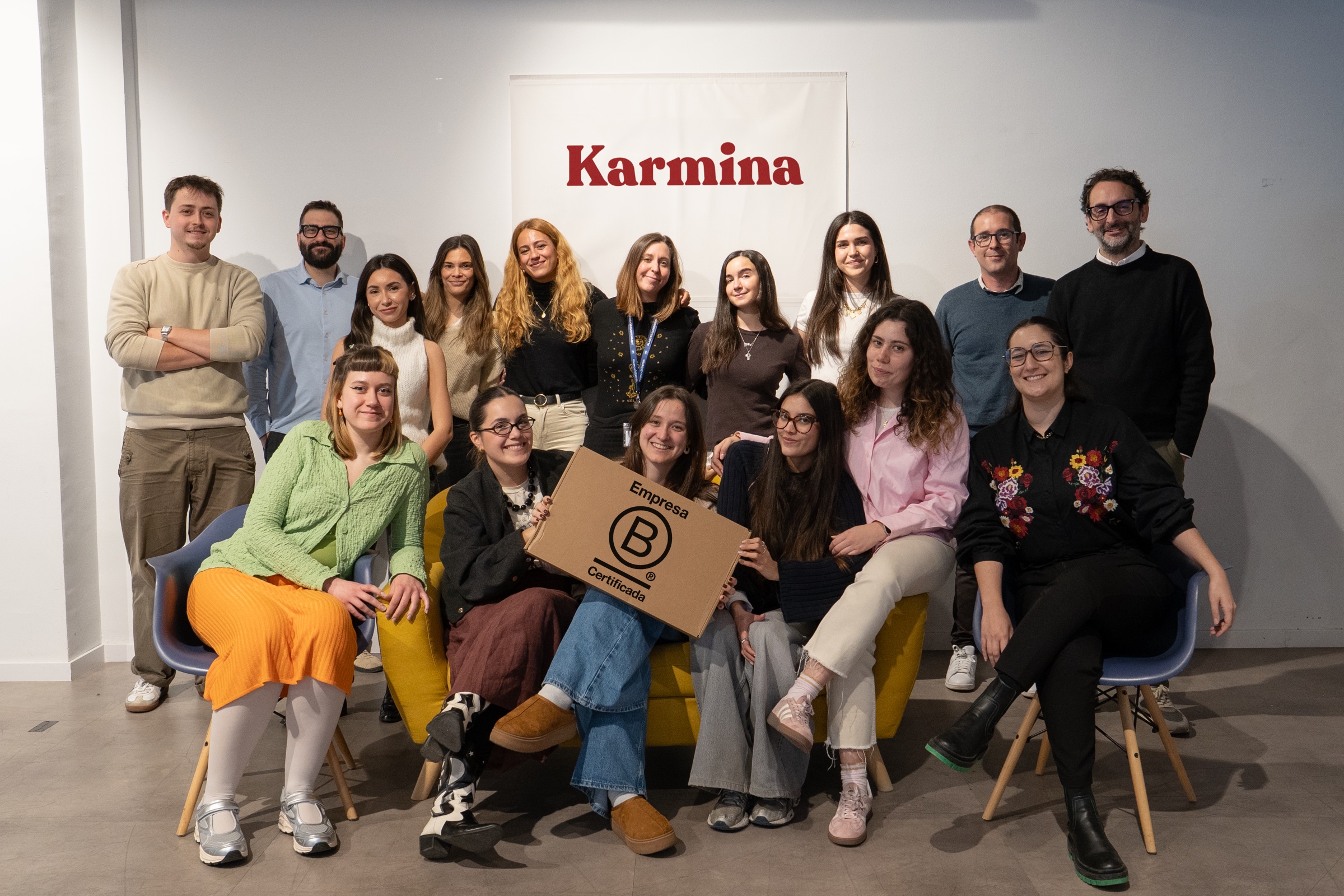
Karmina, the agency behind the Studio
Why Karmina?
Behind Karmina AI Studio there is an agency with track record, team, scale and applied experience in real organizations.
Karmina · AI Studio · Criterio · Dunder Mifflin · Utopiq · Smart Team
 +€119mIn advertising investment for clients
Ads Platforms
Partners MetaGoogle Ads
 TikTok
 Pinterest
 Barcelona
Madrid
Buenos AiresOur offices · Meet the team ↗
+50 KCommunity
 B CorpCertified company
The team
People who connect knowledge and practice


Arnau Sanz
Agentic Strategy & AI Transformation Lead

Ignasi Llorente
AI Partnerships & Business Director

Martina Díaz
AI Finance & Business Intelligence Director

Daniel Mallén
AI Operations & Workflow Lead

Eva Trigo
Generative Creative Director

Ariadna Miranda
AI Administration & Knowledge Operations Lead

Claudia Gonzalez
AI Client Success Manager

Jonan Basterra
AI Social Strategy Director

Laura Sabio
Agentic Social Media Lead

Agustina Córdoba
Content AI Specialist

Alba Gómez
Social Listening Specialist

Paola Cudeiro
AI Client Success Specialist

Roger López
AI Project & Workflow Specialist

Mar Berzal
AI Content Strategy Lead

Andrea Gallego
Community Intelligence Specialist

Candela de la Fuente
Content AI Specialist

Blanca Gómez
AI Community Operations Specialist

Cintia Armajach
Content AI SpecialistLet’s talk
Let's talk about Support Desk
Tell us about your situation, even if the challenge is not fully defined. A member of our team will respond to understand the process and discuss a first step.
hello@karmina.ai