




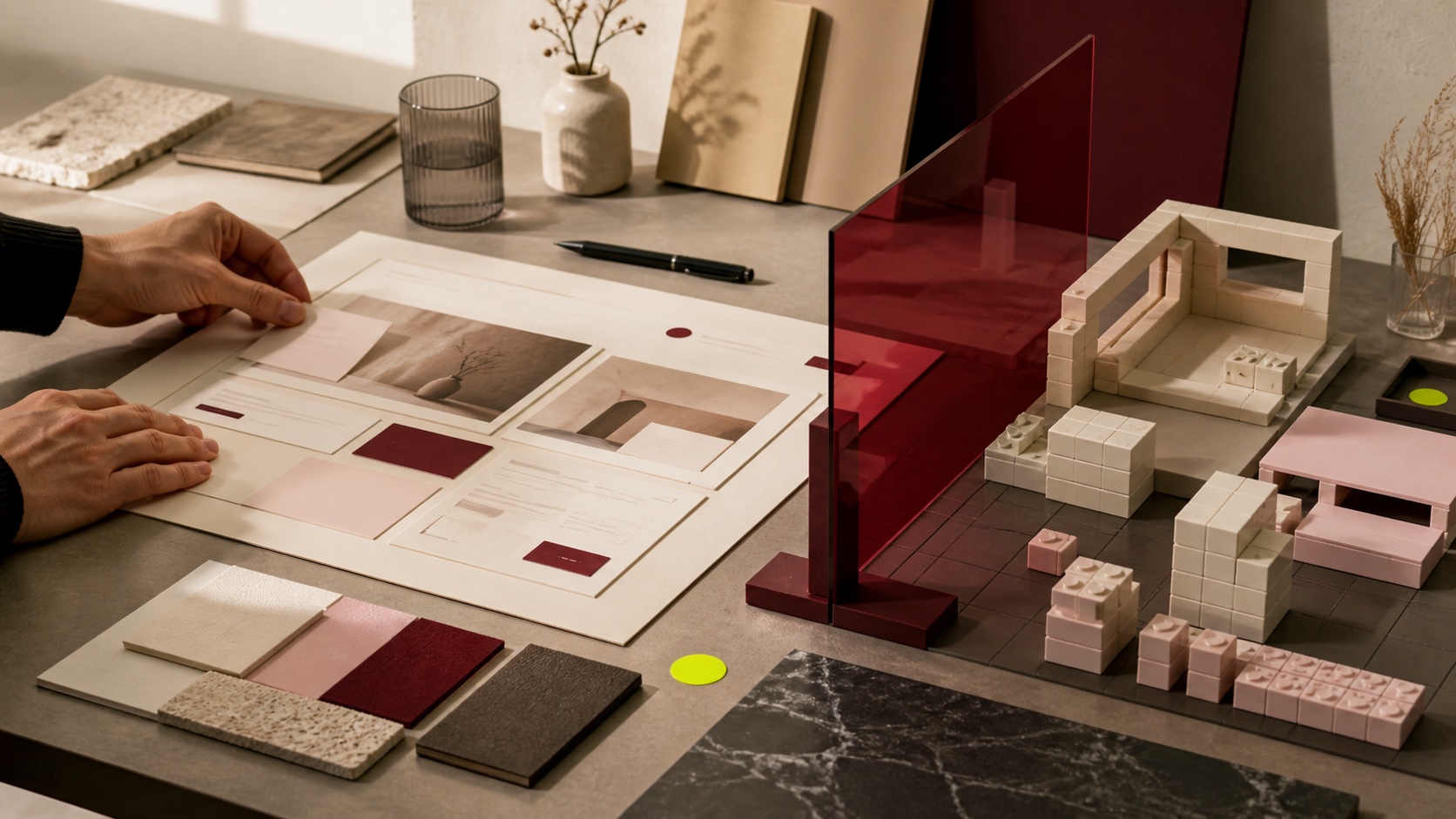
Artificial intelligence can go from a description to a functional page in a very short time. This speed is extraordinary when the team already knows what they want to communicate. It can also consolidate too soon a confusing hierarchy, a generic promise, or an unresponsive business experience. Design before building with AI is not returning to a slow process: it is introducing a reviewable decision before the code multiplies the cost of the change.
The source of this reading is the post and the visible excerpt from “Full Guide: How To Use Claude Design Inside Claude Code”, shared by Tom Crawshaw ↗. Content presents a flow to describe, view, and modify a design before building the page. We have not been able to consult the complete guide in this execution, so we do not make a product tutorial: we adapt the principle to a branding and implementation process.
Seeing a decision changes the quality of the conversation
A brief may look clear until it becomes a screen. When the team sees the hierarchy, they may wonder if the main promise is understandable, if the tests come at the right time, if the form asks too much and if the mobile version keeps meaning. These questions are more difficult to activate in front of an abstract document.
The prototype does not serve only to choose colors. It makes business decisions visible: what we prioritize, what we leave out, what route we propose and what action we ask for. Visualization is a governance tool because it converts diffuse intentions into options that can be approved or rejected.
A Human Gate before production
A Human Gate is a point where the system needs a human decision before continuing. In a landing page, this point can come when the structure, the main content and a sufficient visual representation already exist, but not all interactions, variants and integrations have yet been developed.
The review should answer specific questions. Does the page explain what each offer is? Does the tone correspond to the mark? Do the claims have support? Does the order help you decide? Do links connect to real services? Is there sensitive information or pending visual rights? When the answer is clear, the agent can build with much more autonomy.
The AI needs a direction, not just an aesthetic preference
Saying “make it more premium” or “breathe” can guide a conversation, but it’s not enough to guarantee consistency. A design direction must include hierarchy, rhythm, proportions, palette, typography, photo treatment, movement, accessibility, and responsive behavior. It should also explain the relationship between the identity and purpose of the project.
Criterio, the Karmina ecosystem design studio, provides this strategic layer. The AI can explore variants and accelerate execution; brand management decides which options reinforce an identity and which only follow a visual trend.
Landing Builder and Site Builder don't do the same job
The Landing Builder can transform an approved brief into a campaign-oriented page, a service or a concrete capture. The Site Builder works on a broader architecture: navigation, templates, relationships between pages and shared components. Separating the roles prevents a punctual need from altering without wanting the entire web system.
Both can consult the same brand playbook, but they need different criteria and tests. A landing page can be evaluated for clarity, conversion, and continuity with the campaign. A complete site also needs consistency between routes, maintainability, accessibility, technical SEO and a consistent experience.
It is not necessary to approve each pixel
Introducing human review does not mean turning every change into a meeting. The system can automatically work within approved ranges: spacing, components, styles, proportions or image treatments. Intervention is necessary when the promise, the structure, a data, a brand asset or an action with external impact changes.
This distribution reduces the retroball. The team approves decisions that condition the outcome and lets the agent execute the repeatable part. Subsequent corrections are documented: if a rule is repeated, it becomes part of the system; if it is an exception, it is linked to the project.
Accelerating after you have understood
The best contribution of the AI to the design is not to produce more screens. It allows the team to see before, compare better and build only when the direction is solid enough. The prototype becomes a decision space, not a decorative piece.
The sequence is simple: describe the purpose, represent an option, revise it with criteria, correct it and then build. Speed stops competing with the criterion because the criterion decides where the speed should go.